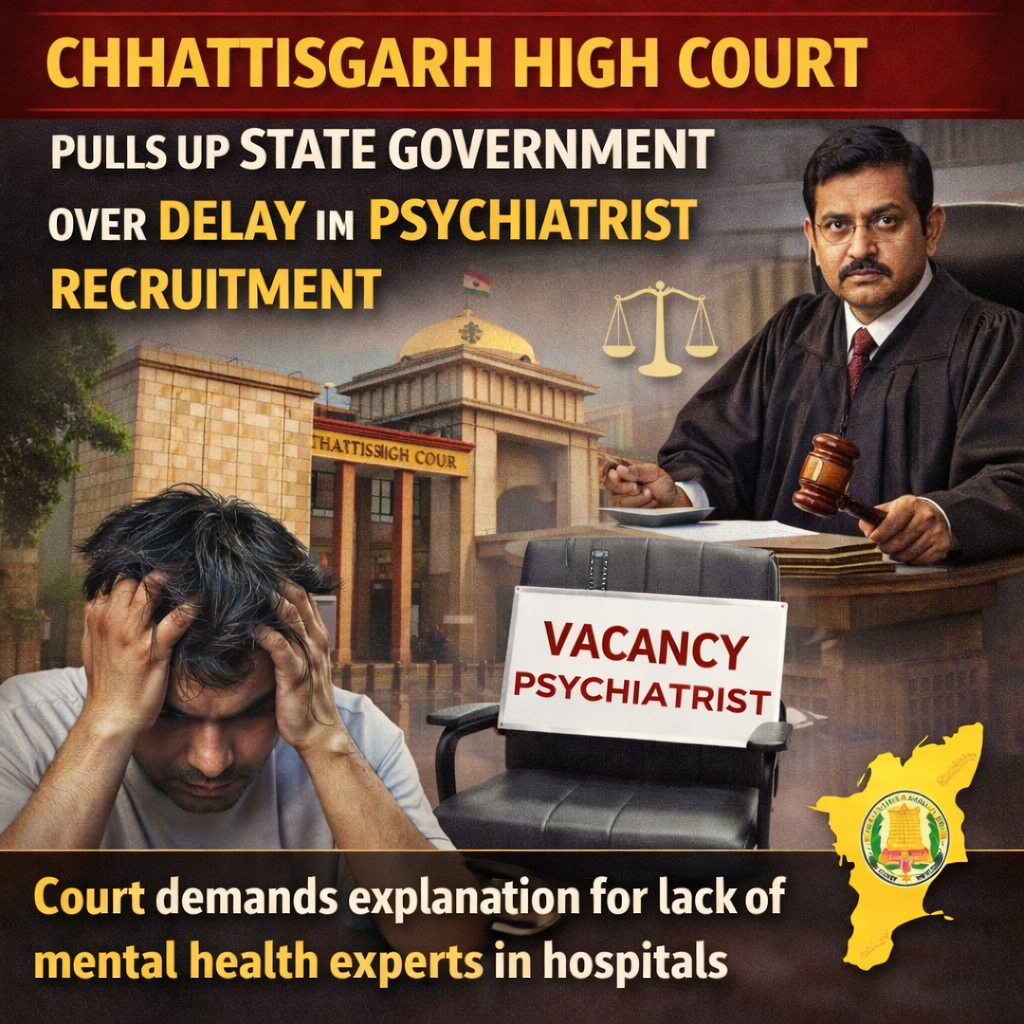
A division bench comprising Chief Justice Ramesh Sinha and Justice Ravindra Kumar Agrawal noted that prolonged delays in filling specialized posts like MD Psychiatrist cause “serious prejudice to the public at large.” The court has now directed the state to expedite the recruitment process for six MD Psychiatrist positions and complete it at the earliest without any unwarranted delays.
This ruling is not just a local matter it shines a spotlight on a much larger crisis that India is facing when it comes to mental health.
The Background of the Court Order
According to reports, the state had advertised positions for psychiatrists in April 2025, but no candidates were selected. Fresh recruitment steps were initiated in March 2026, with a proposal for six posts forwarded to the Chhattisgarh Public Service Commission (CGPSC) on March 5, 2026. The file is currently pending financial approval from the department.
The High Court observed that seeking repeated approvals on procedural grounds is not justified when it affects public health. The judges expressed trust that the state government will now make sincere and earnest efforts to fill these critical vacancies quickly.
Chhattisgarh like many other states faces a severe shortage of mental health professionals. With only three MD Psychiatry seats available annually at Pt. JNM Medical College in Raipur, the pipeline of qualified specialists remains extremely limited.
India’s Mental Health Crisis in Numbers
India is home to over 1.4 billion people, yet it has only around 9,000 psychiatrists. This translates to roughly 0.7–0.8 psychiatrists per 100,000 population far below the World Health Organization’s recommended minimum of 3 per 100,000.21
The treatment gap is even more alarming:
- Nearly 80–85% of people suffering from mental disorders in India do not receive timely or adequate care.
- Common mental disorders and substance use disorders have some of the highest treatment gaps.
- Around 60% of mental disorders are now being diagnosed in individuals below the age of 35, showing that the crisis is affecting younger populations at an alarming rate.20
Suicide remains one of the leading causes of death among Indians aged 15–39, and mental health issues contribute significantly to this statistic. Yet, mental healthcare continues to receive less than 1% of the national health budget in many years.
In Chhattisgarh specifically, the shortage is acute. The state runs District Mental Health Programmes (DMHP) in several districts, but most are managed by non-specialists due to the lack of trained psychiatrists and psychologists. This leads to delayed diagnosis, improper treatment and overburdened families.
Why Does This Shortage Matter So Much?
Mental health is no longer a “silent” issue. Post pandemic awareness has increased, and more people are seeking help. However, the infrastructure has not kept pace. When government hospitals lack psychiatrists:
- Patients in rural and semi-urban areas have to travel long distances or rely on quacks.
- Emergency mental health crises (severe depression, psychosis, suicidal ideation) go unaddressed.
- Families bear enormous emotional and financial stress.
- The overall productivity of the state suffers students drop out, workers lose jobs and communities weaken.
The Chhattisgarh High Court’s intervention through this PIL underscores a growing judicial recognition that access to mental healthcare is a fundamental right linked to the right to life under Article 21 of the Indian Constitution.
What Can Be Done? Practical Solutions for the Future
The court order is a strong nudge, but real change requires sustained action at both state and national levels. Here are some practical steps that can help bridge the gap:
- Increase Postgraduate Seats: Expand MD Psychiatry seats in medical colleges across Chhattisgarh and other states. Even doubling the current intake would make a big difference over the next 5–7 years.
- Attractive Incentives for Doctors: Offer better pay packages, rural posting allowances, loan waivers, and assured career progression for psychiatrists joining government service.
- Strengthen Tele Mental Health Services: Expand initiatives like Tele MANAS (dial 14416) and integrate AI assisted triage tools so that basic counselling reaches remote areas while specialists focus on complex cases.
- Public-Private Partnerships: Collaborate with private hospitals and NGOs to run satellite mental health clinics in underserved districts.
- Reduce Stigma Through Education: Launch widespread awareness campaigns in schools, colleges and workplaces. Early intervention can prevent many cases from becoming severe.
- Streamline Recruitment Processes: Avoid repeated procedural delays. Set fixed timelines for advertisements, exams, and joining accountability at every step is key.
A Ray of Hope
The Chhattisgarh High Court’s firm stand sends a clear message: mental health cannot be treated as a secondary priority. Governments must move beyond paperwork and treat psychiatrist recruitment with the same urgency as other critical healthcare needs.
India has made some progress National Mental Health Programme, District Mental Health Programmes in over 700 districts, and the Mental Healthcare Act 2017 are all steps in the right direction but implementation remains the biggest challenge.
As citizens, we can play our part too. Talk openly about mental health, support organizations working in this space, and hold our elected representatives accountable for delivering on healthcare promises.
What do you think?
Has your state faced similar delays in mental health recruitment? Share your experiences in the comments below. If this article helped raise awareness, please share it with your friends and family. Together, we can push for a mentally healthier India.