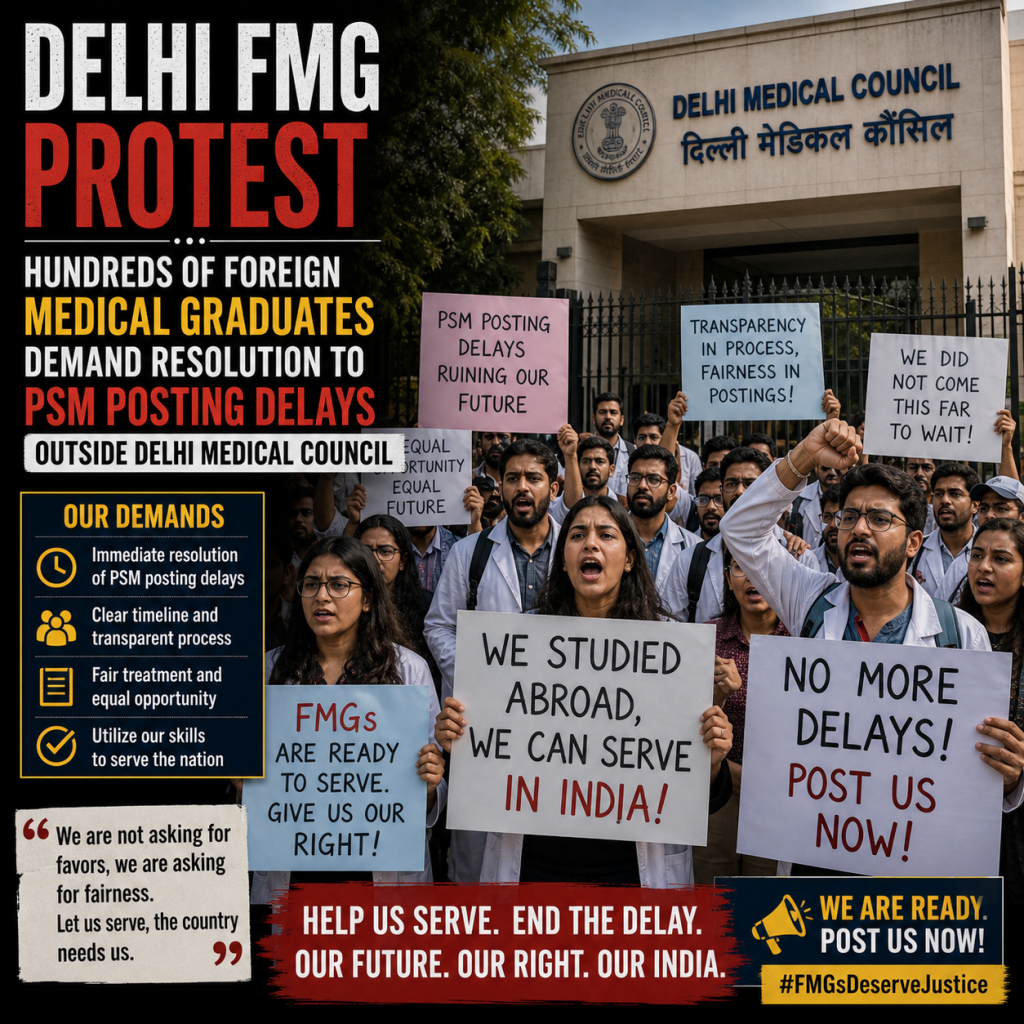
It was just after 10 in the morning on May 5, 2026 when a crowd of young doctors began gathering outside the Delhi Medical Council office in New Delhi. Many carried handwritten placards that read “We cleared FMGE, now let us finish our internship” and “No more bureaucratic hurdles.” By noon, their numbers had swelled to nearly 300. The air was thick with frustration but protest remained peaceful a clear sign that these foreign medical graduates (FMGs) had reached their limit after months of waiting.
This wasn’t just another demonstration. It was the visible breaking point of a long running administrative tangle that has left hundreds of qualified doctors unable to complete their mandatory one year internship.
Protest That Unfolded Today
Protestors mostly in their mid-20s had cleared the Foreign Medical Graduate Examination (FMGE) as recently as January 2025. They had already finished most of their Compulsory Rotating Medical Internship (CRMI) in various Delhi hospitals. The only piece missing was the three month Preventive and Social Medicine (PSM) posting, a crucial rotation focused on community health, epidemiology and public health programmes.
Instead of being allotted postings in Municipal Corporation of Delhi (MCD) hospitals, which traditionally handle PSM training, the interns found themselves stuck in a loop between three authorities: the Delhi Medical Council (DMC), Municipal Corporation of Delhi (MCD) and the National Medical Commission (NMC).
One protester who preferred not to be named, summed it up simply: “We are not asking for special treatment. We just want to finish what we started so we can finally begin our careers.”
What Is PSM Posting and Why Does It Matter?
Preventive and Social Medicine (PSM) also called Community Medicine, is not an optional add on. Under NMC rules every medical graduate whether trained in India or abroad must complete a full 12 month internship that includes a dedicated three month PSM rotation.
During this posting interns work in urban and rural health centres, participate in national health programmes like immunisation drives and disease surveillance and learn how to address public health challenges at the grassroots level. It is designed to produce doctors who understand not just hospital medicine but also prevention and community care skills India desperately needs.
For FMGs who studied in countries like Russia, Georgia, Ukraine or the Philippines, this PSM component is often the final gatekeeper before they receive permanent registration and become eligible to practise independently or appear for NEET PG. When this gate stays closed for months, ripple effects are serious.
Administrative Deadlock Explained
Current crisis began in early 2026. Following a Supreme Court directive, NMC made it mandatory for all interns to receive a stipend during their training. MCD hospitals, which usually accommodate PSM postings for non teaching institutions cited insufficient funds and paused new allotments. Delhi Medical Council on the other hand expressed willingness to start the postings but sought clear written guidance from the NMC on whether FMGs could submit a voluntary undertaking to forgo the stipend temporarily. NMC has yet to issue a definitive clarification.
Result? A classic bureaucratic triangle where each body points to the other. FMGs who should have started their PSM rotation in February or March 2026 are still waiting in May. Some have now been in limbo for over two months. This is not a new problem unique to 2026. Similar delays have surfaced in previous years, but the combination of the stipend rule and lack of quick coordination has turned a manageable backlog into a full blown crisis for this batch.
Real Life Impact on Young Doctors
Take the example of Dr. Ananya Rao (name changed) who completed her MBBS from a recognised university in Georgia. She cleared FMGE in the January 2025 session, joined her internship in a Delhi hospital in mid 2025 and was on track to finish everything by April 2026. Today she is still waiting for her PSM allotment.
“I have already spent extra time and money preparing for FMGE,” she told fellow protesters. “Every extra month of delay means I am further away from starting my PG preparation or even taking up a job. My family back home is worried. I am worried.”
Stories like Ananya’s are common. Many FMGs have already invested four-and-a-half to six years abroad, cleared a tough licensing exam, and now find their final step blocked by paperwork. The mental toll is heavy anxiety, loss of motivation and in some cases, questions about whether they should have chosen this path at all. On a larger scale, these delays reduce the number of new doctors entering India’s healthcare system at a time when rural and semi urban areas continue to face shortages.
Practical Steps FMGs Can Take While Waiting
If you or someone you know is caught in this situation, here are concrete actions that can help:
- Document everything— Keep copies of all emails, application receipts, and internship completion certificates. A clear paper trail strengthens any future representation.
- Send polite but firm follow ups— Write to both DMC and NMC with specific dates of previous communications. Many interns have found that repeated, well documented requests eventually get attention.
- Consider a voluntary undertaking— If NMC eventually allows it, prepare a clear affidavit stating you are willing to forgo the stipend for the PSM period. Have it ready so you can submit it the moment clearance arrives.
- Join peer support groups— Active Delhi FMG associations and Instagram communities are sharing real time updates and collective strategies. There is strength in numbers.
- Look after your mental health— Several FMGs have started small study groups or counselling sessions while they wait. Burnout is real when uncertainty stretches for months.
- Explore legal options carefully— Some batches in the past have approached the courts. This should be a last resort and done through recognised associations rather than individually.
What Could Happen Next?
The good news is that all three bodies NMC, DMC and MCD have acknowledged the issue. A quick clarification from the NMC on the stipend undertaking could unlock postings within days or weeks. Past experience shows that once the green signal is given, allotments happen relatively fast.
Until then protest today serves as a reminder that behind every file and every clarification request are real young doctors whose careers and lives are on hold.
Final Thoughts
FMG protest in Delhi today is not just about one batch of interns. It highlights a deeper need for smoother coordination between central and local bodies when it comes to medical education and licensing. India produces some of the world’s finest doctors through the FMG route, yet administrative friction sometimes makes their journey unnecessarily difficult.
If you are an aspiring FMG, lesson is clear: plan for the full journey including the possibility of small delays and stay connected with the community. If you are already in the system and waiting know that you are not alone hundreds are standing with you. The path to becoming a doctor in India is long and demanding. The least the system can do is ensure that once you clear every academic and licensing hurdle, the final administrative steps do not become the biggest obstacle.
Stay informed. Stay united and keep pushing for the clarity that will let these dedicated young doctors finally complete their training and serve patients who need them.
FAQ
1. What is PSM posting for FMG interns?
Preventive and Social Medicine (PSM) is a mandatory three month rotation in community health settings that forms part of the 12 month Compulsory Rotating Medical Internship (CRMI). It focuses on public health programmes, epidemiology, and preventive care.
2. Why are Delhi FMGs facing PSM posting delays right now?
The delay stems from an administrative deadlock. MCD hospitals cite funding issues for stipends (now mandatory), while DMC is waiting for clear NMC guidance on whether FMGs can voluntarily forgo the stipend to start postings immediately.
3. Can FMGs practise medicine without completing the PSM component?
No, full 12 month internship including PSM, is required for permanent registration with the medical council. Without it, FMGs cannot appear for NEET PG or practise independently.
4. What should FMGs do while waiting for PSM allotment?
Keep all documents ready, send regular documented follow ups to DMC and NMC, prepare a voluntary undertaking affidavit in advance, join active FMG support groups for updates, and prioritise mental well being through peer networks or counselling.
5. Is there any expected timeline for resolution?
No official timeline has been announced yet. However, once the NMC issues clarification on the stipend issue, allotments are expected to move quickly based on past patterns. FMG associations continue to engage with authorities for the fastest possible resolution.
This situation affects real careers and ultimately, patient care across India. If you are directly impacted, keep engaging constructively with the authorities while supporting your peers. The solution lies in faster coordination and every voice that stays calm but persistent helps move the needle.
Disclaimer
This post is for informational and educational purposes only. It does not constitute medical advice, legal opinion or an official investigation. Readers should consult qualified healthcare professionals for personal health concerns. All details are drawn from media reports and outcomes of any official inquiry may provide further clarity.