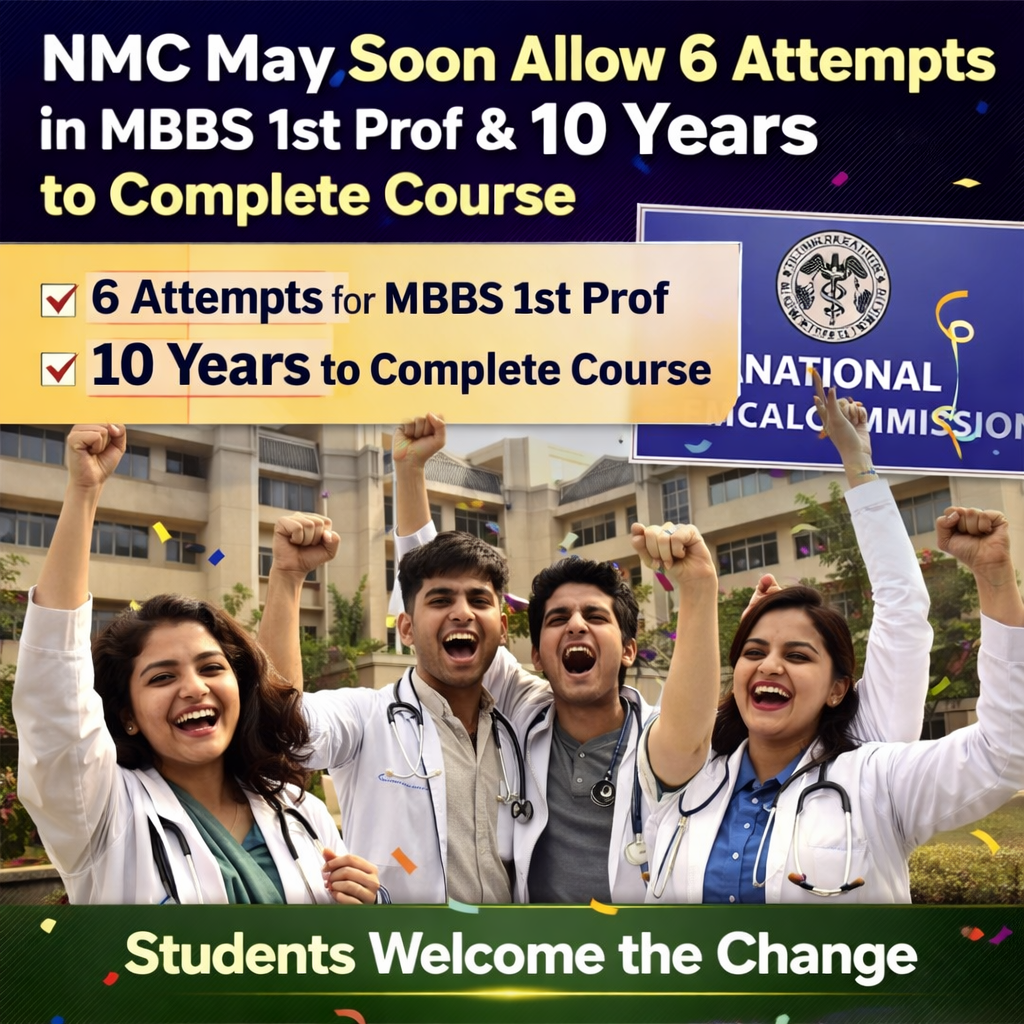
It has also proposed extending the maximum time to complete the entire MBBS course (including the compulsory internship) from 9 years to 10 years.
This news has sparked hope among thousands of medical students and aspirants across the country. For many, the first year of MBBS is the biggest hurdle and this proposal could make the journey a little less daunting.
Current NMC Rules for MBBS First Professional Exams
Under the National Medical Commission’s Graduate Medical Education Regulations (GMER) 2023, MBBS students currently get a maximum of four attempts to pass the First Professional examination. This exam covers three core subjects: Anatomy, Physiology and Biochemistry. Additionally, no student is allowed to continue the undergraduate medical course beyond nine yearsfrom the date of admission. These rules were introduced to ensure high academic standards and to prevent students from lingering in the system indefinitely.
While the intention is to maintain quality, many students and educators have pointed out that the first year comes with unique challenges. Fresh out of school, students suddenly face a massive syllabus, new teaching methods, hostel life and intense competition often leading to higher failure rates in the initial attempts.
What Exactly Has the Parliamentary Panel Suggested?
The Parliamentary Standing Committee on Health and Family Welfare has taken a more student centric view. Key recommendations include:
- Increasing attempts for the 1st Professional MBBS exam from 4 to 6.
- Extending the total course duration from 9 years to a maximum of 10 years from the date of admission.
The panel noted that limiting students to just four attempts can be “overly stringent” for those who are still adjusting to the demanding nature of medical education. They emphasised a more humane approach without compromising the overall rigour of the MBBS programme.
Why the First Year of MBBS Feels So Tough
The 1st Professional year is widely considered one of the most challenging phases in the entire MBBS journey. Here’s why:
- Vast theoretical content (especially Anatomy, which requires heavy memorisation)
- Shift from rote learning in school to conceptual understanding
- Limited practical exposure in the initial months
- High academic pressure combined with personal adjustments (new city, hostel, peer competition)
Failure rates in the first year can sometimes range from 15% to as high as 50–60% in certain colleges. Many bright students who cleared NEET with flying colours still struggle initially. The current four-attempt rule often leaves little room for genuine learning curves or personal setbacks.
Potential Benefits of the Proposed Changes
If the NMC accepts these recommendations, here’s what students could expect:
- Lower stress levels – Knowing you have two extra attempts can reduce panic and allow focused preparation.
- Better learning outcomes – Students can truly understand concepts instead of cramming just to pass.
- Reduced dropouts – Fewer students will be forced to leave the course midway due to early academic setbacks.
- Mental health support – It acknowledges the real psychological pressure faced by young doctors-in-training.
- More inclusive system – Talented students who need a little extra time to adjust won’t lose their dream career.
Will This Affect the Quality of Future Doctors?
This is a fair question many people are asking. Critics might worry that more attempts could dilute standards. However, the panel has kept the increase moderate (only two extra attempts) and still tied it to a reasonable overall timeline of 10 years.
Becoming a competent doctor is not just about clearing exams quickly it’s about building strong clinical skills, empathy, and lifelong learning habits. A slightly more flexible foundational year might actually help students develop these qualities better in the long run.
What Should Current and Future MBBS Students Do?
This is still a recommendation NMC has to review it and issue an official notification before it becomes a rule. Until then:
- Continue preparing seriously for your exams.
- Don’t rely solely on future relaxations build strong fundamentals from Day 1.
- Seek help early: Join study groups, consult seniors, or use reliable resources for Anatomy, Physiology, and Biochemistry.
- Focus on time management and consistent revision rather than last minute cramming.
Students who are already in MBBS or preparing for NEET should keep an eye on official NMC updates in the coming weeks.
A Step Towards Student -Friendly Medical Education
The parliamentary panel’s suggestion is a welcome and progressive move. Medical education in India is intense by design and it should be. But the first year shouldn’t feel unreasonably punishing for students who are genuinely committed. This balanced recommendation seems to strike the right chord between maintaining high standards and showing compassion towards young minds who are stepping into one of the toughest professions.
What do you think? Should the NMC implement these changes? Do you support more attempts for the MBBS 1st Professional exams? Drop your thoughts in the comments below I’d love to hear from current MBBS students, aspirants, parents, and doctors!
This article is for informational purposes only. Always refer to the latest official notifications from the National Medical Commission (NMC) for accurate updates.