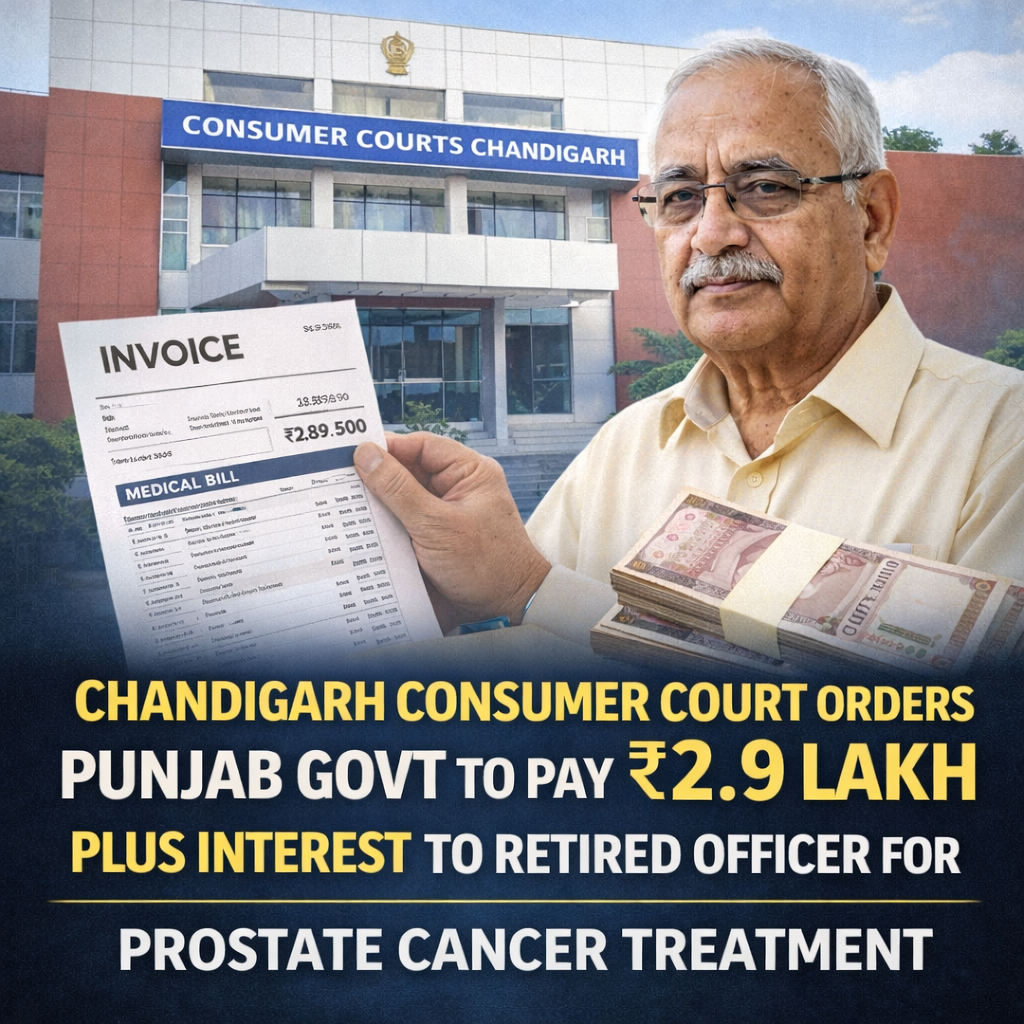
In March 2026, District Consumer Disputes Redressal Commission in Chandigarh delivered a significant ruling that has caught the attention of thousands of government employees and pensioners across Punjab. A retired deputy district attorney named Ajaib Singh who battled prostate cancer was awarded the remaining ₹2.90 lakh of his medical expenses, along with 9% annual interest and ₹20,000 in compensation for the hassle he endured.
This wasn’t a case of medical negligence by doctors. It was about something many retirees quietly worry about: whether the government will fairly reimburse life saving treatment costs when you follow all the rules. If you or a loved one is a Punjab government pensioner or even if you’re just concerned about healthcare costs in India, this story offers practical clarity on your rights and what can go wrong if they’re ignored.
Today, we’ll walk through exactly what happened, why the court sided with the patient and the actionable steps you can take to protect yourself in similar situations. No legal jargon just straightforward insights based on the official order and common experiences of retirees.
What Happened: The Facts of the Ajaib Singh Case
Ajaib Singh retired from the Punjab government’s prosecution department as a Deputy District Attorney. In 2018, he was diagnosed with prostate cancer a serious condition that required prompt surgery and hospital care. He chose Fortis Hospital in Mohali, a well known private facility and was admitted from October 8 to December 24, 2018.
Total bill came to ₹4,01,951 like any responsible retiree, Singh gathered every receipt, bill and document and applied for reimbursement under the Punjab government’s medical attendance rules. In January 2021, authorities (Director Prosecution and Litigation along with the Health and Family Welfare Department) approved only ₹1,11,750 that left him short by nearly ₹2.9 lakh out of pocket for treatment he had already paid for himself.
Frustrated, Singh approached the District Consumer Disputes Redressal Commission in Chandigarh in August 2021. On March 16, 2026, the commission presided over by President Mr. Amrinder Singh Sidhu and Member Mr. B.M. Sharma partly allowed his complaint. They directed the Punjab government to pay:
- The full balance of ₹2,90,201
- 9% interest per annum from the date the complaint was filed (August 17, 2021) until the money is actually paid
- An additional ₹20,000 as compensation for the mental harassment and litigation expenses
Government had argued that reimbursement in private hospitals is capped at government fixed rates under the Punjab Services (Medical Attendance) Rules, 1940 and that Singh had signed an undertaking agreeing to those limits but the court found the key missing piece: there was no proof that those limits or package rates were ever clearly explained or provided to him in writing before treatment.
Commission called the partial payment “arbitrary” and a clear case of “deficiency in service.” They noted that for a life threatening illness like cancer, genuine expenses backed by proper documents should not be denied without transparency.
How Medical Reimbursement Works for Punjab Government Pensioners
Most Punjab government employees and retirees are covered under the Punjab Services (Medical Attendance) Rules, 1940 and related policies. These allow reimbursement for treatment in government hospitals at full cost and in private empanelled hospitals up to certain package rates.
The catch? Private hospitals often charge more than the government rates especially for specialized cancer care. Retirees are expected to sign an undertaking that they’ll accept reimbursement “as per rules” but as this case shows, simply signing a form isn’t enough if the government doesn’t share the actual rates or explain the implications upfront.
This isn’t unique to Punjab. Similar rules exist in many states, but enforcement and communication often fall short. Retirees frequently discover the caps only after submitting bills sometimes years later leaving them financially strained at a vulnerable time.
Why Court’s Reasoning Matters
The commission didn’t rewrite the rules. Instead, it emphasized fairness and transparency core principles of consumer protection law. Under the Consumer Protection Act, 2019 government departments providing services (including medical reimbursement) can be held accountable for deficiency in service.
Key takeaways from the judgment:
- An undertaking or affidavit alone doesn’t bind someone if the full terms weren’t disclosed.
- For serious illnesses, denying genuine, documented expenses without justification amounts to unfair trade practice.
- Pensioners who served the government for decades deserve clear communication about their benefits.
This ruling aligns with several other consumer court decisions across India where partial reimbursements were challenged successfully when policies weren’t properly communicated.
Real World Impact: Who This Affects and Why It Matters
Stories like Ajaib Singh’s are more common than we admit. Cancer treatment costs in India can easily cross ₹3–5 lakh even for moderate cases. For a retiree living on a fixed pension, losing ₹2.9 lakh isn’t just inconvenient it can mean dipping into savings meant for grandchildren’s education or emergency needs.
Many pensioners choose private hospitals because government facilities may have long waiting lists or limited advanced oncology services. The expectation is that reimbursement will at least cover a fair portion. When it doesn’t and when the process feels opaque trust breaks down.
This case also highlights a broader issue: healthcare inflation outpaces government package rates. What was “reasonable” a few years ago may no longer cover actual costs in 2026.
Practical Tips to Protect Your Medical Reimbursement Rights
Here’s what every Punjab government employee or retiree (and their families) should do right now:
- Get the Policy Details in Writing Before Treatment
Contact your department’s medical reimbursement cell or the Health Department and ask for the latest government approved package rates for your condition. Keep email records or a written acknowledgment. - Understand the Undertaking You Sign
Don’t treat it as a formality. Ask for a copy of the exact rates and conditions. If the hospital is not empanelled or rates are unclear, consider government facilities or clarify coverage beforehand. - Maintain Bulletproof Documentation
Keep originals and copies of every bill, discharge summary, doctor’s prescription, investigation reports and payment proofs. Scan them digitally too. - File Promptly and Follow Up
Submit claims within the stipulated time (usually 3–6 months). If partially rejected ask for a detailed speaking order explaining the deductions. - Know When to Escalate
If you believe the rejection is unfair, you have up to two years to approach the District Consumer Court. Filing is relatively simple and inexpensive compared to civil courts. - Consider Supplementary Options
Many retirees now opt for personal health insurance or top up policies to bridge gaps. Some associations of government employees also offer group mediclaim schemes.
Small steps like these can prevent years of stress and financial loss.
Common Questions About Medical Reimbursement and Consumer Courts
Q1: Can I claim full reimbursement if I go to a private hospital?
Not always automatically. Reimbursement is usually limited to government rates unless the policy allows full coverage in emergencies or specific cases. However, if rates were not properly disclosed, you may have a strong case in consumer court, as seen here.
Q2: How long does the consumer court process take?
District commissions aim to resolve cases within 3–5 months, though complex matters can take longer. Appeals can go to State or National Commissions. In this case, the matter moved relatively efficiently.
Q3: Do I need a lawyer to file a complaint?
No. You can file as a self represented litigant. Many commissions have help desks, and the process is designed to be user-friendly for ordinary citizens.
Q4: What if my treatment was years ago am I still eligible?
Limitation is generally two years from the date the cause of action arose (e.g., date of rejection). However, if ongoing correspondence happened, it may extend. Always check with the commission.
Q5: Does this ruling apply only to cancer cases?
No. The principles transparency, non arbitrary decisions and accountability for deficiency in service apply to any medical reimbursement dispute involving government servants or pensioners.
Final Thoughts: Your Health Benefits Are a Right, Not a Favor
The Chandigarh consumer court’s decision in Ajaib Singh’s case is more than a one off victory. It’s a reminder that government medical reimbursement isn’t optional charity it’s a promised benefit earned through decades of service. When departments fail to communicate clearly, courts are ready to step in and enforce fairness.
If you’re a retiree or supporting one, take a moment today to review your medical policy documents. Talk to your department’s welfare officer. Share this information with colleagues and family members. Knowledge truly is the best protection when health costs rise unexpectedly. Cases like this don’t just restore money they restore dignity and peace of mind at a time when patients and families need it most. Stay informed, document everything and don’t hesitate to seek justice when rules are applied unfairly.
Link: As reported by Indian Express
https://indianexpress.com/article/cities/chandigarh/consumer-panel-asks-punjab-govt-to-compensate-pay-medical-reimbursement-of-rs-2-90-lakh-to-retired-attorney-10631578/lite/
Disclaimer
This post is for informational and educational purposes only. It does not constitute medical advice, legal opinion or an official investigation. Readers should consult qualified healthcare professionals for personal health concerns. All details are drawn from media reports and outcomes of any official inquiry may provide further clarity.