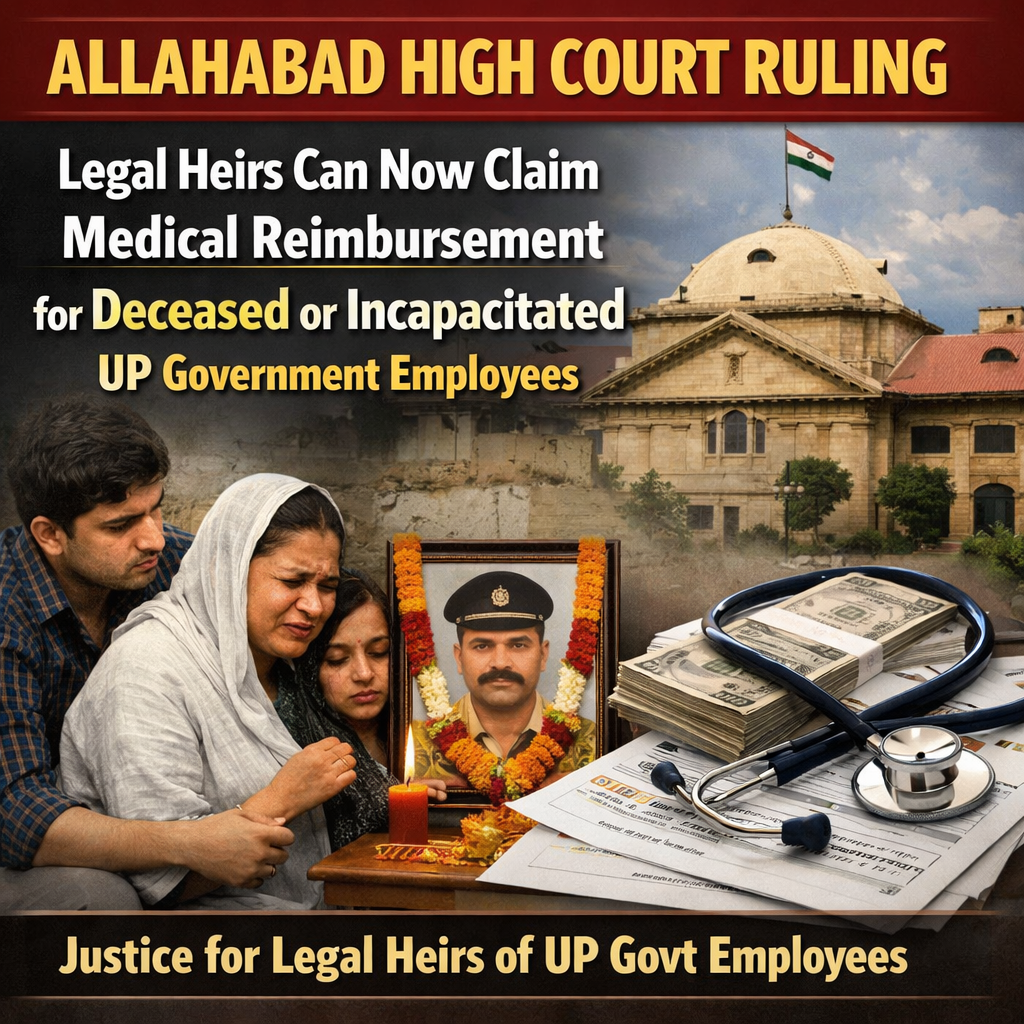
This ruling directly addresses long standing hardships faced by families when technical rules previously blocked rightful claims. If you or a loved one works (or worked) in Uttar Pradesh government service, this decision could be a game changer for your family’s financial security during medical emergencies.
What Exactly Did the Allahabad High Court Rule?
On March 28, 2026 Justices Alok Mathur and Amitabh Kumar Rai delivered the verdict in a petition filed by Chandra Choor Singh. The court applied the legal principle of “reading down”to Rule 16 of the Uttar Pradesh Government Servants (Medical Attendance) Rules, 2011.
Previously, Rule 16 allowed only the “beneficiary” (the serving or retired government employee/pensioner) to submit reimbursement claims. Government departments often rejected claims filed by family members after the employee’s death, citing this technicality even when huge medical bills from treatment in private hospitals remained unpaid.
The court held that this narrow interpretation was arbitrary and violative of Article 14of the Constitution (right to equality). Instead, the judges gave “beneficiary” a broader, liberal meaning. Now, legal heirscan file claims if:
- The employee or pensioner dies during treatment
- The employee becomes incapacitatedand unable to file the claim themselves, and
- No other surviving beneficiary is available.
The judgment emphasizes that families should not be deprived of this legitimate benefit in their hour of need.
Why This Ruling Is a Big Deal for UP Government Families
Uttar Pradesh has lakhs of serving and retired government employees. Medical emergencies don’t wait for paperwork deadlines. Many families have faced rejection of genuine bills simply because the employee passed away mid treatment.
This ruling removes that barrier. It recognizes that medical reimbursement is not just a perk for the employee it’s a family welfare measure. By “reading down” the rule, the court has made the policy more practical and compassionate.
Real life impact:
- Widows, children or other legal heirs can now recover costs of life saving treatment.
- Reduces financial stress during grief.
- Sets a precedent for similar cases across India.
Who Can Claim Under This New Interpretation?
Eligible claimants include:
- Legal heirs (spouse, children, parents, or other dependents as per succession laws)
- In cases where the employee/pensioner:
- Died while undergoing treatment (government or private hospital)
- Was incapacitated (e.g., coma, severe disability) and couldn’t file
- Left no other surviving beneficiary
Important note:The claim must still meet all other conditions of the 2011 Rules genuine treatment, approved procedures, proper documentation etc.
Step by Step Guide: How Legal Heirs Can Now File a Claim
Here’s a practical checklist based on the updated interpretation:
- Gather Documents
- Death certificate (if applicable)
- Medical bills, prescriptions, discharge summary
- Proof of relationship (affidavit, succession certificate, or legal heir certificate)
- Employee’s service details / PPO number (for pensioners)
- Original treatment records from government-approved or empanelled hospitals
- Submit the Claim
- Approach the concerned department’s medical reimbursement cell
- Clearly mention the High Court ruling and Rule 16 “read down” interpretation
- File within reasonable time (courts have often treated limitation periods as directory in such cases)
- If Rejected
- You can approach the Lucknow or Allahabad bench of the High Court citing this precedent.
Pro tip: Keep digital and physical copies of everything. Consult a local government employees’ association or a service lawyer for faster processing.
Broader Context: How This Fits with Existing Benefits
This judgment builds on the spirit of the 2011 Rules, which already provide generous medical coverage to UP government servants and pensioners. It aligns with constitutional values of equality and welfare.
Similar progressive rulings have come from other High Courts in recent years, showing a growing judicial trend toward protecting family rights in service benefits.
What Should Serving & Retired Employees Do Now?
Don’t wait for an emergency:
- Update your family on medical reimbursement rules and keep records organized.
- Nominate legal heirs clearly in service records.
- Consider supplementary health insurance if your coverage has gaps.
- Share this article with colleagues and retired associations.
Final Thoughts: A Victory for Common Sense and Compassion
The Allahabad High Court’s decision is more than legal jargon it’s a message that government welfare schemes exist for the well being of entire families not just individuals on paper. In times of loss, families should not have to fight bureaucracy for basic reimbursements.
This ruling will ease the burden for countless households across Uttar Pradesh. If you’re a government employee, pensioner, or family member, celebrate this as your win too.
Disclaimer:This article is for information purposes only and is not legal advice. Always consult your department’s competent authority or a qualified lawyer for your specific case. Rules and interpretations may evolve.
Frequently Asked Questions (FAQs)
Q1: Can legal heirs claim reimbursement even if the employee died in a private hospital?
Yes, as long as the treatment was genuine and meets the criteria under the 2011 Rules.
Q2: Is there a time limit for filing the claim?
The court has emphasized a liberal approach; strict limitation periods are often treated as directory in heir cases.
Q3: Does this apply only to serving employees or also pensioners?
It applies to both government servants and pensioners.
Q4: What if multiple heirs exist who files?
Any legal heir can file with proper authorization or joint application; departments usually accept claims from the primary heir.
Q5: Where can I read the full judgment?
It will soon be available on the Allahabad High Court website (elegalix.allahabadhighcourt.in) under relevant writ petitions.
If this ruling affects you or your family, feel free to drop your questions in the comments below. I’ll try to answer based on publicly available information.