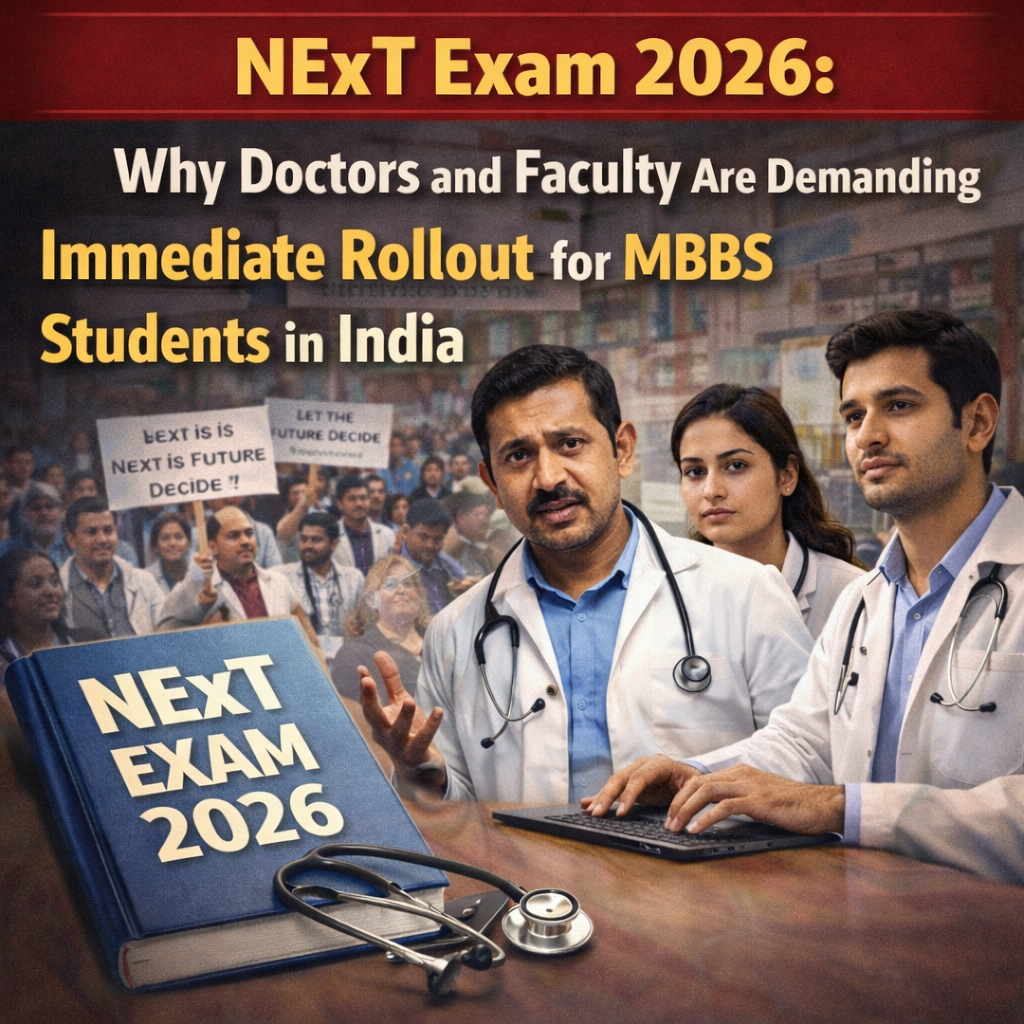
Doctors, faculty members and residents from top institutions including AIIMS New Delhi, AIIMS Nagpur, AIIMS Patna and Ram Manohar Lohia Hospital have collectively urged the National Medical Commission (NMC) to roll out the National Exit Test (NExT) immediately for MBBS students.
The call is clear: the current system of fragmented university exams is no longer enough. Students, colleges and the entire healthcare ecosystem deserve a standardized, transparent and reliable evaluation process. If you’re an MBBS student, parent or aspiring doctor, this development could reshape your future.
In this comprehensive guide, we break down everything you need to know about the NExT exam, why experts are pushing for its immediate implementation, the potential benefits challenges and practical tips to stay prepared.
What is the National Exit Test (NExT)?
The NExT exam is India’s proposed single window exit test for all MBBS graduates. Introduced under the National Medical Commission Act, 2019, it is designed to serve three critical purposes:
Act as the final qualifying examination for MBBS students (replacing traditional university final year exams).
Function as the gateway for postgraduate (PG) medical admissions (replacing NEET-PG).
Serve as the licensing exam for foreign medical graduates (replacing FMGE).
Format (as planned):
Step 1: Theory based, objective (MCQ) exam testing knowledge across 19 subjects.
Step 2: Practical and clinical skills assessment evaluating real world patient management.
Once fully implemented, NExT will ensure that every doctor practicing in India meets the same national benchmark regardless of whether they studied in a government college in Delhi or a private institution in a smaller city.
Why the Current MBBS Exam System Needs Fixing
India produces over 1.5 lakh MBBS graduates every year, yet the quality of assessment varies wildly between universities and states. Some common pain points include:
Inconsistent evaluation standards across different medical colleges.
Lack of uniformity in practical and clinical skill testing.
Over reliance on rote learning rather than competency based assessment.
Delays in result declaration that affect PG admission timelines.
Doctors and faculty argue that these inconsistencies are harming patient care in the long run. A standardized national exam like NExT would bring accountability to medical colleges and push them to maintain higher teaching standards.
Key Arguments from Doctors and Faculty for Immediate Rollout
The April 2026 editorial makes a strong case for fast-tracking NExT. Here are the main points raised:
Standardization is long overdue: A single national exam will eliminate regional disparities and ensure every graduate is equally competent.
Better learning outcomes: Knowing that a high stakes national test awaits will motivate students to focus on conceptual understanding and clinical skills throughout their MBBS journey.
Improved healthcare delivery: Better trained doctors mean better patient outcomes, especially in rural and underserved areas.
Transparency and meritocracy: NExT will make PG seat allocation fairer and reduce allegations of favoritism in current systems.
Global alignment: Many countries already follow a national licensing + exit test model. India needs to catch up to produce world-class doctors.
The signatories, including senior faculty from premier AIIMS institutes, believe that further delays are hurting students who have already invested years in their education under the new competency based curriculum.
Benefits of NExT for MBBS Students, Colleges & the Healthcare System
Clear benchmarks to improve teaching quality and infrastructure
Healthcare System
More skilled doctors entering the workforce annually
Patients
Higher standard of care from newly qualified doctors
Beyond these, NExT is expected to reduce the stress of multiple entrance exams and bring Indian medical education closer to international standards like the USMLE.
Concerns: Is India Truly Ready for Immediate Implementation?
Not everyone agrees on an “immediate” rollout. Some student associations and faculty groups (including voices from FAIMA) have raised valid concerns:
Insufficient time for mock tests and infrastructure upgrades in smaller colleges.
Need for at least 2–3 years of phased preparation and pilot runs.
Anxiety among current final-year students who prepared under the old system.
Logistical challenges in conducting a practical clinical skills exam on such a large scale.
The NMC had earlier indicated a gradual rollout with mock tests spread over 3–4 years. The current debate is essentially between “speed with safeguards” versus “phased and safe implementation.”
What Does This Mean for Current and Future MBBS Students?
If NExT is rolled out in 2027 or 2028 as demanded:
Batch 2021–22 and later students will likely be the first to appear.
Final-year students in 2026–27 may get a hybrid model or extended preparation window.
Focus will shift heavily toward clinical case based questions and practical skills from the third year onwards.
Pro tip: Start treating every clinical posting, ward duty, and case discussion as NExT preparation right now. The emphasis will move from “what to remember” to “how to apply knowledge at the bedside.”
Current Status of NExT Exam (April 2026)
As of now, the NMC has not announced an official implementation date. The April 6 editorial has reignited the conversation, and many expect the Commission to respond within the next few weeks. Keep an eye on the official NMC website,Medical Drafts and Medical Dialogues for the latest updates.
How MBBS Students Can Prepare for NExT Right Now
Even if the exact date is not confirmed, smart preparation can begin today:
Shift from rote learning to clinical reasoning and case-based studies.
Practice MCQs from all 19 subjects daily (focus on high-yield topics).
Actively participate in ward rounds and OP D postings.
Use standard textbooks (Harrison’s, Bailey & Love, Robbins) alongside latest NExT oriented question banks.
Join peer study groups for clinical skill practice (history taking, examination, counseling).
Stay updated with official NMC notifications.
Final Thoughts: A Historic Opportunity for Indian Medical Education
The call for immediate NExT rollout is more than just an exam reform it is a demand for excellence in medical training. While concerns about readiness are legitimate, the medical fraternity’s unified voice shows that the time for change is now.
For aspiring doctors, this is both exciting and challenging. The students who adapt early and build strong clinical foundations will be the ones who thrive under the new system.
What are your thoughts on the NExT rollout? Should it happen immediately or follow a phased approach? Drop your views in the comments below. we’d love to hear from current MBBS students, interns, and faculty!
FAQs About NExT Exam 2026
Q1. Will NExT completely replace NEET-PG? Yes, once fully implemented, NExT Step 1 scores will be used for PG admissions.
Q2. When is the first NExT exam expected? No official date yet. The April 2026 editorial is pushing for rollout as early as possible.
Q3. Is NExT only for MBBS students in India? It will apply to all MBBS graduates seeking to practice or pursue PG in India, including foreign medical graduates.
Q4. How many attempts are allowed in NExT? Details are still being finalized, but early indications suggest limited attempts similar to NEET-PG.
Q5. Where can I get official updates? Follow the National Medical Commission website (nmc.org.in) and trusted portals like Medical Drafts, Medical Dialogues.
Final year MBBS student with strong clinical knowledge in medicine, pharmacology, pathology and evidence based research. In depth knowledge of global geopolitics and its effects on healthcare systems, supply chains and international health regulations
The National Testing Agency has officially announced the new date for the NEET UG 2026 re examination after cancelling the earlier exam due to the alleged paper leak controversy. The re exam will now be conducted on June 21, 2026, affecting more than 22 lakh medical aspirants across India.
PMOS, previously known as PCOS, is a newly renamed condition that better reflects its hormonal and metabolic effects beyond the ovaries. The change from Polycystic Ovary Syndrome to Polyendocrine Metabolic Ovarian Syndrome highlights its association with insulin resistance, obesity, fertility issues, and long term health risks affecting millions of women worldwide.
A doctor in Bhilwara allegedly attempted suicide by consuming phenyl after accusing a private hospital operator of financial exploitation, unpaid salary, mental harassment, and police inaction. The incident has sparked concern over workplace conditions and disputes in the medical profession.