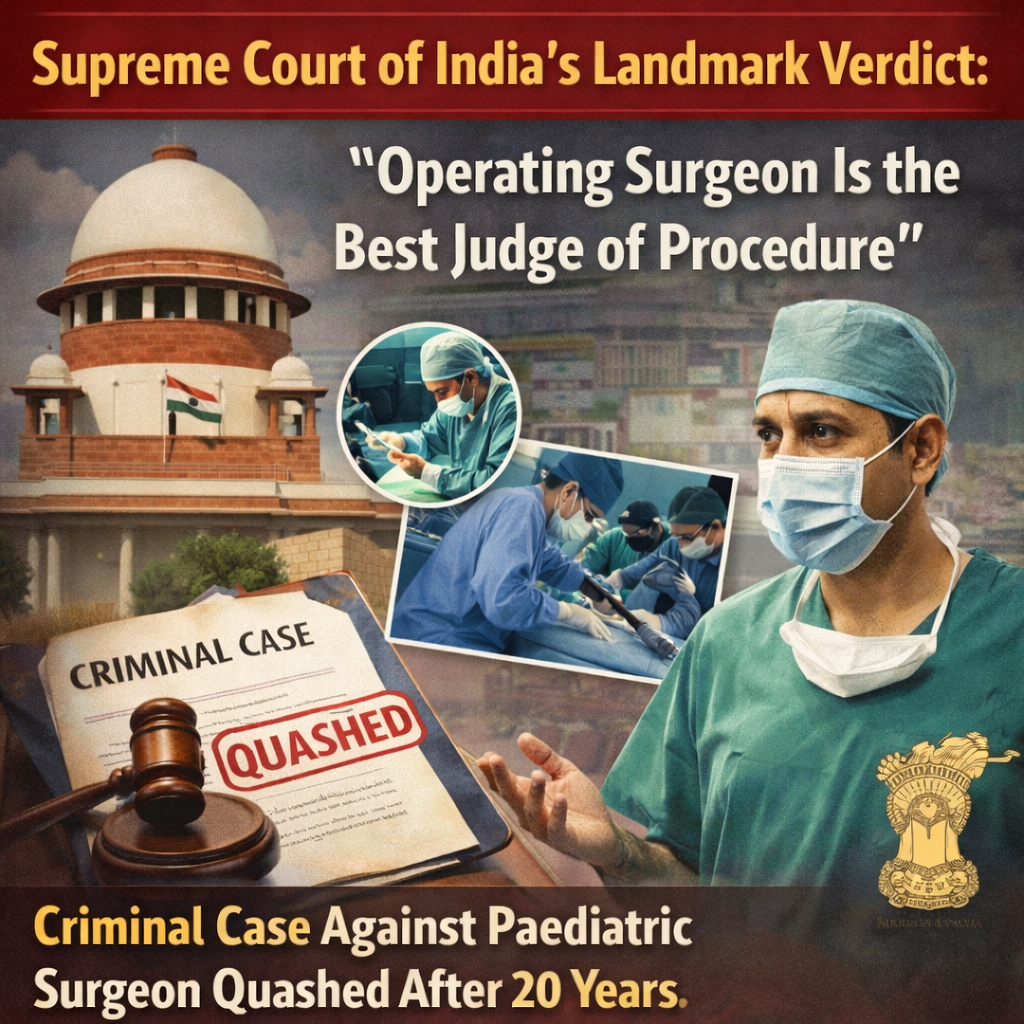
This doctor friendly judgment is being hailed as a major step toward protecting clinical judgment from unwarranted criminal prosecution and could reshape how consent and medical negligence cases are viewed in Indian courts.
What Was the Case All About?
The incident dates back to the mid 2000s. A one and a half year old boy was diagnosed with an undescended testicle (cryptorchidism), a common congenital condition. The child’s father gave consent for orchidopexya standard procedure to surgically fix the testicle in the scrotum to prevent future complications like infertility, torsion or cancer risk.
During the operation, the paediatric surgeon, Dr. S. Balagopalencountered a situation where the testicle was found to be dysplastic (abnormally developed). Instead of proceeding with fixation, he performed an orchidectomy(surgical removal of the testicle). The father later alleged that:
- He had never consented to removal of the organ.
- The consent form was allegedly altered (interpolated) after the surgery to include permission for orchidectomy.
- The surgeon acted without proper authorisation.
A criminal complaint was filed, leading to proceedings that dragged on for nearly 20 yearsin the lower courts. The Madras High Court had earlier refused to quash the case, prompting the surgeon to approach the Supreme Court.
Supreme Court’s Key Observations
A bench comprising Justices P.S. Narasimha and Manoj Misradelivered the verdict on April 6, 2026 allowing the surgeon’s appeal and setting aside the High Court’s order.
In its well reasoned judgment, the Supreme Court made several crucial points:
- Surgeon’s clinical discretion is paramount: “The operating surgeon is the best judge of which one of the two procedures is to be adopted” during surgery, especially in unforeseen medical situations.
- Medical Board’s expert opinion carried weight: An independent Medical Board had examined the case and concluded that orchidectomy was an appropriate and recognised alternative in such scenarios to mitigate long term risks like malignancy in an undescended dysplastic testis.
- No evidence of malice or forgery: The Court found “no material on record that alternative surgery, namely, Orchidectomy, was entered by a different ink or in a different handwriting.” There was nothing to suggest criminal intent or tampering.
- Continuing the case would be an abuse of process: The bench observed that dragging the doctor through criminal proceedings for two decades, despite expert medical validation, amounted to harassment and misuse of the judicial system.
The Court quashed the entire criminal proceedings in C.C. No. 13 of 2008 pending before the Judicial Magistrate, declaring it necessary “to secure the ends of justice.”
Why This Ruling Is a Game Changer for Doctors in India
India has seen a sharp rise in criminal cases against doctors in recent years, often filed under IPC sections for negligence or cheating. Many of these stem from intraoperative decisions where the surgeon must act swiftly based on real time findings something patients and families may not fully anticipate at the time of signing consent forms.
This judgment reinforces three important principles:
- Informed consent is not absolute: While proper consent is essential, courts recognise that surgical procedures can evolve based on intra-operative discoveries. Doctors cannot be penalised criminally for exercising professional judgment backed by medical science.
- Expert medical opinion matters: Reliance on Medical Board reports can protect doctors from baseless allegations.
- Protection against prolonged litigation: Frivolous or prolonged criminal trials cause immense mental and professional stress. The Supreme Court has now drawn a clear line against such “abuse of process.”
For patients, the ruling is equally reassuring. It does notdilute the importance of consent or accountability. Instead, it promotes trust in the medical system by discouraging misuse of criminal law in complex clinical scenarios.
Broader Impact on Medico Legal Landscape
Medical bodies like the Indian Medical Association (IMA) have long advocated for safeguards against “defensive medicine” where doctors avoid high risk procedures or order unnecessary tests just to protect themselves legally. This verdict could encourage more confident clinical practice while still upholding patient safety.
It also aligns with earlier Supreme Court observations in cases like Jacob Mathew vs. State of Punjab(2005), which laid down guidelines to prevent harassment of doctors in negligence cases.
Key Takeaways for Doctors and Patients
- For doctors: Always document consent meticulously (including possible alternatives). Intra operative decisions should be noted clearly. Seek second opinions or Medical Board references in grey areas.
- For patients and families: Discuss risks and possible alternative procedures openly before surgery. Understand that surgeons may need flexibility during the operation.
- For the system: Faster resolution of medico legal disputes and better integration of expert medical evidence can reduce unnecessary court battles.
Final Thoughts
The Supreme Court’s clear stance that “the operating surgeon is the best judge of procedure” is not just a win for one doctor it’s a victory for rational, evidence based healthcare in India. In an era where medical litigation is on the rise, this judgment strikes a much needed balance between patient rights and professional autonomy. As the healthcare sector evolves with new technologies and complex procedures, such rulings will play a vital role in building a supportive environment for doctors while ensuring justice for patients.
What are your thoughts on this ruling? Should there be stricter guidelines for consent forms or is clinical judgment enough? Share your views in the comments below!
Note: This is a news analysis based on the Supreme Court judgment dated April 6, 2026. For legal advice, please consult a qualified professional.