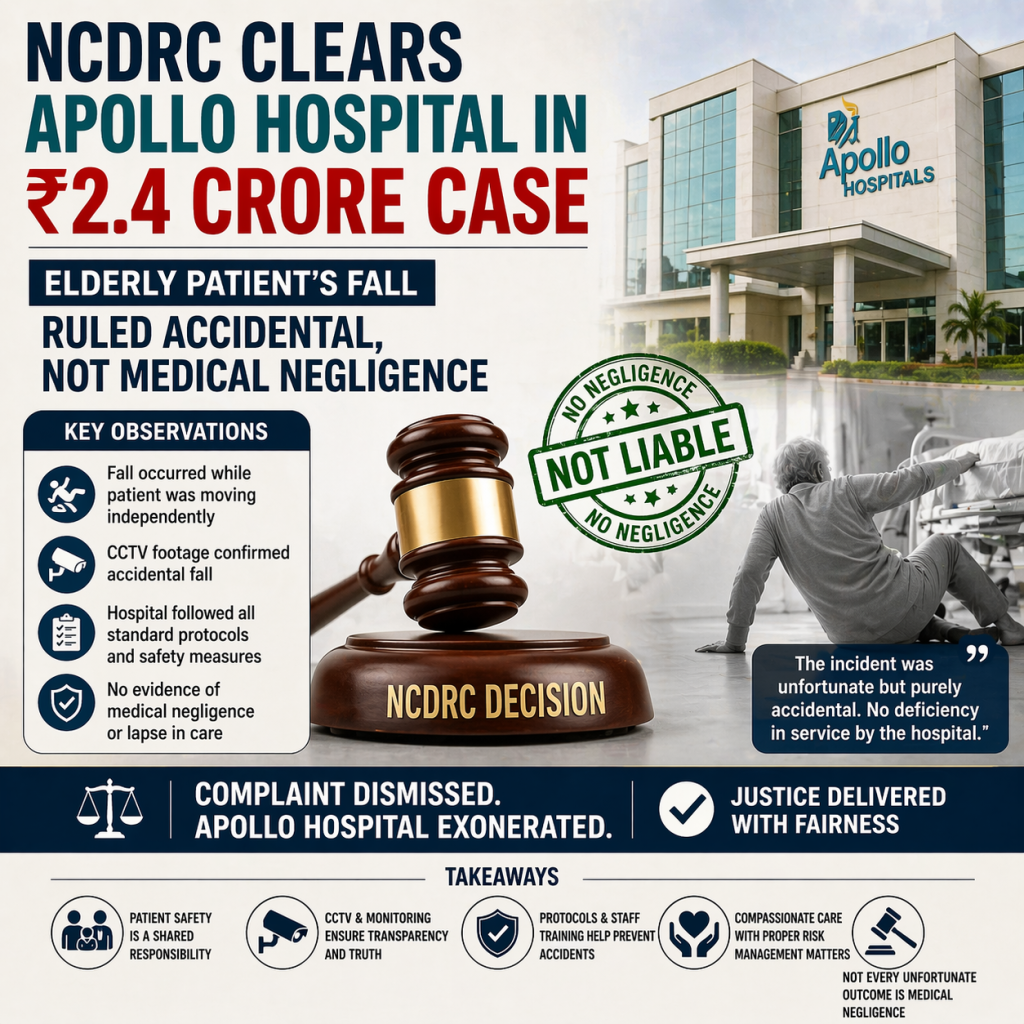
On 21 April 2026, National Consumer Disputes Redressal Commission (NCDRC) ruled that Apollo Hospital in Hyderabad cannot be held accountable for an accidental fall suffered by a 90 year old patient. Family had filed a complaint seeking around ₹2.42 crore in compensation, alleging medical negligence. Apex consumer court looked at the facts and said no this was simply an unfortunate accident not proof of any failure on the hospital’s part.
This decision isn’t just about one family and one hospital. It shines a light on a bigger question many of us face: When does a mishap in a hospital cross the line into medical negligence and when is it just one of those things that can happen despite everyone’s best efforts? Let’s walk through it step by step, in plain language, so you can understand your rights, your responsibilities, and how to stay safer next time you or a loved one needs hospital care.
Case in Simple Terms
Patient identified in court records as J.N. Mehra had already fallen at home and was admitted to Apollo Hospital Hyderabad back in 2017 for treatment of an infection. He was in a private room with an attendant present. During his stay, he fell from the hospital bed. His family argued that the hospital staff should have done more to prevent it better monitoring, perhaps raised side rails or closer supervision.
NCDRC examined the evidence and disagreed. Court noted that the fall appeared accidental, there was no clear proof of any breach in the standard of care and the presence of an attendant meant the hospital had taken reasonable steps. In the end commission dismissed the complaint entirely stating the hospital could not be held liable for every accidental incident. It’s a reminder that Indian courts don’t treat every bad outcome as negligence. They look for evidence that the hospital or doctor failed to do what a reasonably competent professional would have done in similar circumstances principle often called the Bolam test in medical law.
Medical Negligence vs Accidental Fall: Where’s the Line?
This is where things get practical. Not every slip or fall in a hospital equals negligence.
Medical negligence generally requires four things (the classic legal test):
- The hospital or doctor owed a duty of care.
- There was a breach of that duty (they didn’t follow accepted medical standards).
- The breach directly caused the harm.
- The patient actually suffered damage as a result.
An accidental fall on the other hand, can happen even when staff are doing everything right. Elderly patients often have weak muscles, poor balance, confusion from illness or multiple medications that affect stability. Hospitals can’t strap every patient down 24/7 that would create other risks.
In this Apollo case, NCDRC essentially said: “We see no evidence that the hospital ignored known risks or failed to provide basic safety measures.” Contrast that with other rulings where hospitals were held responsible for instance, when a patient fell from a faulty trolley left unattended or side rails were missing on a high risk patient. Those cases involved clear lapses in equipment or protocol. The takeaway? Courts look at the specific facts not just the outcome.
Why This Ruling Matters for Everyday Patients
India sees thousands of medical negligence complaints every year. NCDRC and state commissions handle a huge volume under the Consumer Protection Act, 2019. This decision adds to a body of case law that protects hospitals from being automatically blamed for unavoidable risks but it also quietly reinforces what good hospitals should be doing.
For patients and families, it’s empowering. You now know that:
- Simply having a bad result isn’t enough to win a case.
- You need to show a specific failure in care.
- Attendants and family members play a real role in safety.
At the same time, it doesn’t give hospitals a free pass. They still have a legal duty to assess fall risk (especially for elderly, post surgery or medicated patients), provide appropriate aids like bed rails or call bells and train staff.
Practical Tips to Prevent Falls and Protect Yourself
Here’s the part that actually helps you or your loved ones right now.
For patients and families:
- Ask about fall risk assessment. On admission politely ask the nurse or doctor: “Does my parent have a high fall risk? What precautions are in place?”
- Use the call bell. Teach elderly patients to call for help instead of trying to get up alone.
- Bring a family attendant when possible. Many private rooms allow it, and courts note this as a reasonable safeguard.
- Check the bed setup. Make sure side rails are up when the patient is resting, and the bed is in the lowest position.
- Stay hydrated and mobile safely. Dehydration and muscle weakness increase fall risk encourage short, supervised walks if the doctor approves.
- Document everything. If you notice something worrying (broken call bell, wet floor, missing rails), note the date, time and staff you told. It creates a record if issues arise later.
Real life scenario: Imagine your 78 year old mother admitted after a hip fracture. She’s groggy from painkillers. You notice the side rail on one side is down. Instead of assuming the staff forgot, you calmly point it out and ask them to raise it. That small action could prevent a fall and shows you’re engaged, not confrontational.
For hospitals and doctors (a quick note for professionals reading this):
- Document risk assessments clearly in the file.
- Follow standard protocols from bodies like the Indian Nursing Council or hospital accreditation guidelines (NABH).
- Train staff on fall prevention bundles hourly rounding, non slip socks, proper lighting at night.
- Communicate openly with families. Transparency builds trust and reduces complaints.
How the Consumer Protection Act Fits In
Under the Consumer Protection Act, patients are “consumers” and hospital services are “services.” This gives you a relatively fast, low-cost way to seek justice compared to filing a civil suit. The NCDRC is the highest consumer forum and often sets the tone for lower commissions but the Act also demands proof. Frivolous cases waste everyone’s time. This Apollo ruling reinforces that balance protecting genuine victims while shielding doctors and hospitals from hindsight blame.
FAQ: Your Most Common Questions Answered
1. Can I still file a case if my loved one falls in hospital?
Yes but success depends on proving negligence not just the fall. Gather medical records, witness statements and expert opinions early.
2. What should I do immediately after a fall in hospital?
Ensure the patient gets prompt medical attention. Note details (time, witnesses, what was said by staff). Ask for an incident report. Then consult a medical lawyer if you suspect lapses.
3. Are government hospitals treated differently?
The principles are similar, but government facilities sometimes have additional protections under sovereign immunity. Private hospitals like Apollo face higher scrutiny because patients pay for “paid services.”
4. How long do I have to file a complaint?
Usually two years from the date of the incident or when you first became aware of the negligence.
5. Does this ruling mean hospitals don’t have to prevent falls?
Absolutely not. It means they must follow reasonable standards not guarantee zero accidents. Good hospitals already invest heavily in safety.
Final Thoughts: Knowledge Is the Best Protection
The NCDRC’s clear eyed decision in the Apollo Hospital Hyderabad case reminds us that healthcare is a partnership. Hospitals must meet professional standards. Patients and families must stay alert and communicate. Accidents can still happen but informed vigilance reduces them dramatically.
Next time you step into a hospital, go with eyes open, ask questions, Participate in care and remember: a fall doesn’t automatically mean someone failed. It might just mean life threw a curveball.
If you or a loved one ever face a similar situation, document everything, seek clear answers from the treating team and if truly warranted consult a consumer forum or qualified lawyer. Knowing your rights doesn’t mean hunting for lawsuits. It means getting better care from the start. Stay safe, stay informed and take care of each other. Your health and peace of mind is worth it.
Disclaimer
This post is for informational and educational purposes only. It does not constitute medical advice, legal opinion or an official investigation. Readers should consult qualified healthcare professionals for personal health concerns. All details are drawn from media reports and outcomes of any official inquiry may provide further clarity.
Link: According to Medical Dialogues reportshttps://medicaldialogues.in/amp/news/health/medico-legal/hospital-cannot-be-held-accountable-for-accidental-fall-ncdrc-junks-rs-24-crore-medical-negligence-complaint-against-apollo-hospital-hyderabad-169084